
How to instrument a product without slowing it down
Marcus Chen
Lead Performance Engineer
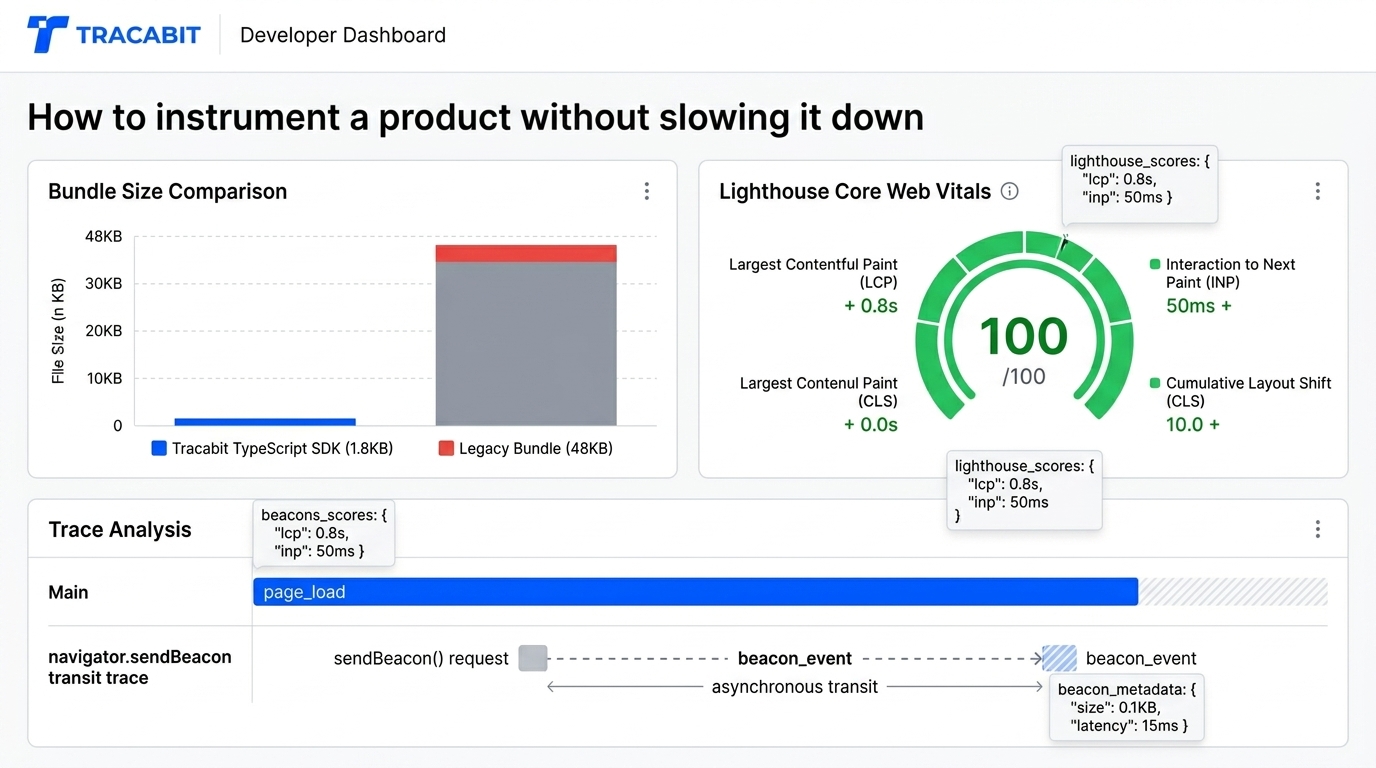
Keeping analytics scripts under 2KB prevents main-thread blocking and preserves 100/100 Google Lighthouse Core Web Vitals.
Loading large multi-kilobyte analytics bundles blocks the main browser UI thread, driving up Interaction to Next Paint (INP) and Largest Contentful Paint (LCP).
Traditional tools bundle polyfills, complex session replay hooks, and client-side visualization engines right into your visitor's browser. This often adds 50KB to 100KB of JavaScript.
Tracabit is written in zero-dependency TypeScript, compiling to under 1.8KB gzipped. All event dispatching happens asynchronously via navigator.sendBeacon, guaranteeing zero impact on UI responsiveness.
// Non-blocking beacon dispatch
export function dispatchTelemetry(endpoint: string, payload: object): void {
  const blob = new Blob([JSON.stringify(payload)], {
    type: 'application/json'
  });
  if (navigator.sendBeacon) {
    navigator.sendBeacon(endpoint, blob);
  } else {
    fetch(endpoint, { method: 'POST', body: blob, keepalive: true });
  }
}
Written by Marcus Chen
Published on August 9, 2026 in Performance
Related Technical Articles
Continue reading deep dives into telemetry and privacy engineering.
Why zero-cookie analytics is the right default
Why consent banners degrade conversion by 28% and why anonymous mathematical minimization solves compliance permanently.
What agents need from your analytics API
Why LLM agents struggle with bloated JSON payloads and how structured Model Context Protocol (MCP) schemas bridge the gap.
The case for agent-readable analytics
Autonomous bots making product decisions need sub-15ms deterministic endpoints without visual UI scraping.
Subscribe to our engineering journal.
Get technical teardowns, release announcements, and privacy engineering articles delivered once a month. No spam, ever.